

Christine Arveil
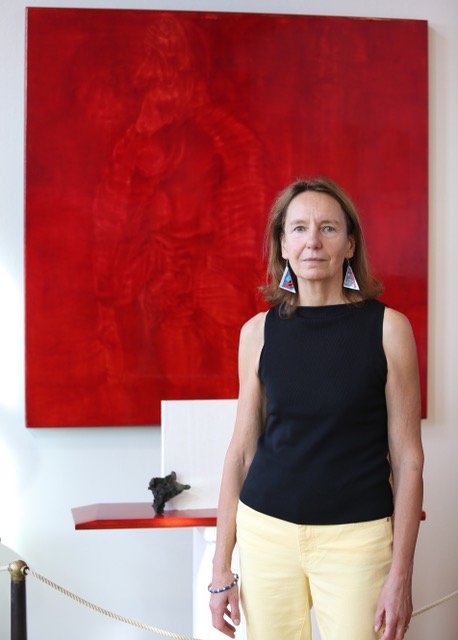
Credit: Romero Leiva
Boston-based artist and writer Christine Arveil uncompromisingly explores layers of the human experience, in pursuit of harmony and beauty beyond distress. Evolving organically across multiple media, her technical proficiency informs the places she creates. She exhibits internationally and steadily collaborates with musicians and performing artists. In her 40 years of experience, she has connected people, communities, and countries through the arts. arveil.com
Art installation for A Far Cry Concert Heart Strings | February 14th, 2026
When Rafael Popper-Keizer and A Far Cry proposed a collaboration on a concert centered on love, the message felt timely. We envisioned the visual environment to foster a calm focus, conducive to deeper listening.
What does love mean? Immediate and elusive, deeply embedded in the human fabric, it remains resistant to definition. Perhaps that is why music and poetry exist— not to explain love, with its contradictions and intensity, but to inhabit it.
In a contemporary world without a pause, sitting together in person to feel and reflect on the human experience is arare chance to discover, or rediscover, the world around us. Beyond its ability to express the unsaid, music shapes time, allowing space for presence and attention. There is a deep connection between time and love, and music exists precisely at this intersection.
My work engages with history, survival, peace and recovery, guided by a search for calm, beauty, and tendresse — that unique blend of gentleness and vulnerability. Love is intrinsic to my artistic pursuit.
This installation was shaped with close attention to the music and responds to Rafael’s vision. When I asked why love for nature was not listed among the concert themes, he suggested that it pervades the entire program. Introducing live organic elements to the stage, creates a natural place where sound can breathe and musicians feel at ease.
I weave together found objects—discarded remnants of the industrial world and materials decaying in nature— to reveal the beauty beneath their surfaces and refuse their rejection. Live flowers complete the installation, lending their fragile, yet powerful vitality with a sense of breathing presence.
While acknowledging the solemnity of Jordan Hall, I attempt to loosen its rigidity. Stands designed after the stage wood paneling extend outward, as if the building itself lent space for flowers and new shapes to emerge from within. A nine-foot swirling bark and evocative transparent structures soften the divide between stage and audience. Like love moves bodies and minds—stirring curiosity and loosening boundaries—the installation allows vulnerability and strength, durable and ephemeral, to coexist. On the right side of the stage, The Builder, an immemorial volcanic basalt from the Azores, stands as a tribute to those who built this space and those who care for it every day.
In the face of world tragedies, art might seem naïve or indulgent. I recently shared this doubt with a young officerand fighter pilot preparing for deployment. His response came without hesitation: “We need all the love we can get; all the peace and beauty artists can offer.”
Art is fundamental to the reinvention of society—not as an escape from reality, but as a way of standing in the world with renewed attention. Art, poetry, music, and performance relentlessly imagine new forms of being and new synergies among all of us who inhabit the same earth. The concert hall is a place of shared comfort for performers and audience alike—a place not only to listen, but to remember, and to speak for a world imbued with love in all its forms.
Poet Sophia de Mello Breyner Andresen once wrote:
I know it would be possible to build the rightful form of a human city, faithful to the perfection of the universe. And so I begin again, endlessly, from the blank page— this is my work as a poet, for the rebuilding of the world.
Christine Arveil would like to dedicate tonight’s installation to Sue and Bernie Pucker.
